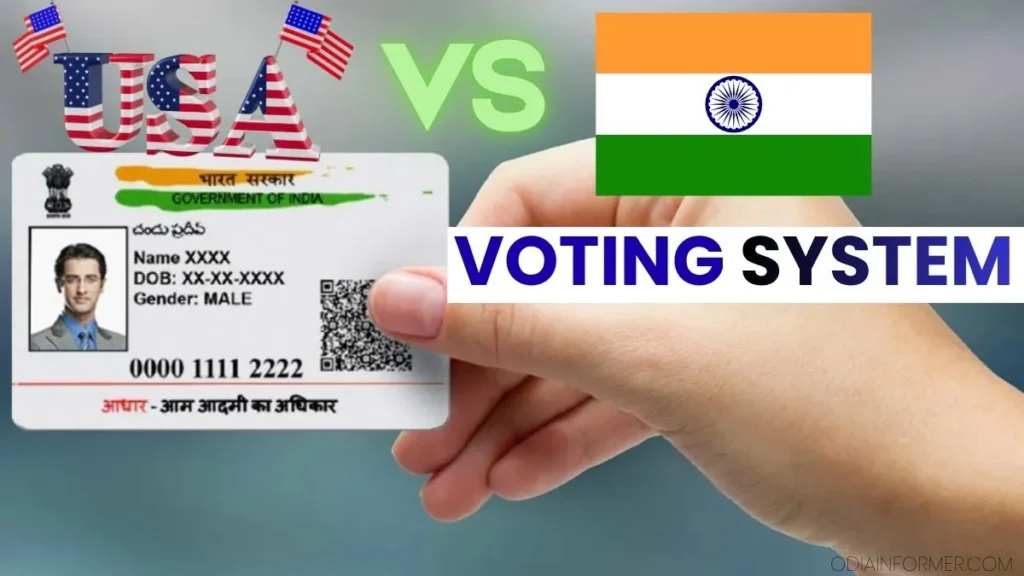
how India’s voter ID system works while pushing for the SAVE America Act. Here’s a complete breakdown of the difference between India and US voting systems.
Should the US Adopt an Election System Like India’s?
Introduction: What’s the Story?
On August 18, 2026, US President Donald Trump posted on Truth Social referencing India’s Chief Election Commissioner Gyanesh Kumar. According to Trump, earlier that month, Kumar had asked the US administration a pointed question — how can elections in the United States be conducted without a valid photo ID?
US Ambassador to India Sergio Gor also amplified the post in support. This whole episode has reignited discussion around the comparison between India and US voter ID systems. It’s worth noting that some misleading and fake posts also went viral around this story — including a false claim that Trump was planning to “take” India’s Election Commissioner to the US. That claim is untrue; the actual tweet was limited to citing India’s election system as an example.
What Did Trump’s Tweet Actually Say?
Trump’s post made a few key claims, which are at the center of the Donald Trump India election tweet discussion:
- India’s most recent general election saw 646 million (64.6 crore) voters participate.
- Less than 1% of votes were cast by mail.
- Every voter was required to show a valid photo identity document before voting.
- Trump used this as an example to renew his push for the SAVE America Act (Safeguard American Voter Eligibility Act) in the US.
This isn’t the first time Trump has made this comparison — back in March 2025, he referenced India and Brazil’s biometric voter ID systems in an executive order on US election reform.
Why Is the US Voting System So Different From India’s?
This is where the most search-worthy part of the story comes in — why voter ID isn’t mandatory everywhere in the US. Unlike India, the US has no single national election system. Voting rules vary state by state:
1. States With Strict Photo ID Requirements
States like Wisconsin, Kansas, Ohio, Indiana, and Georgia require a state-issued photo ID to vote.
2. States With No Document Requirement
In large states like California, Nevada, Oregon, New Mexico, Oklahoma, Minnesota, and New York, no photo ID is required to vote — voters simply state their name and sign a poll book.
3. States With Non-Document Criteria
In some states, a simple affidavit (sworn statement) confirming citizenship is enough — no physical document is required at all.
This patchwork is exactly why the question “why doesn’t the US have a national voter ID” keeps coming up, and it’s the inconsistency the Trump administration is citing as it pushes to get the SAVE America Act through Congress.
What Is the SAVE America Act, and Why Is It Controversial?
The Safeguard American Voter Eligibility (SAVE) Act is a proposed law aimed at:
- Requiring proof of citizenship at the time of voter registration
- Establishing a uniform, nationwide voter ID system
- Tightening rules around mail-in voting
The bill has already passed the House of Representatives, but has repeatedly stalled in the Senate. This is part of a decades-old and deeply divisive US voter ID law debate.
Arguments From Both Sides
This issue is deeply politically polarized in the US, so it’s worth understanding both perspectives:
Arguments in favor (largely from the Republican side):
- Stricter voter ID rules would help prevent election fraud and noncitizen voting
- The White House has pointed to a recent Census Bureau review that reportedly found around 24,000 noncitizen votes
- A single, consistent national system would increase public confidence in elections
Arguments against (largely from the Democratic side):
- Millions of eligible US citizens — particularly low-income, elderly, minority, and rural voters — don’t have easy access to a photo ID
- Strict ID requirements could function as a form of voter suppression
- Independent studies have generally found confirmed cases of noncitizen voting to be extremely rare
This debate runs deep enough that entire books have been written about it — it remains one of the most contested domestic political issues in America, without a single “correct answer” that both sides agree on.
Why Is India’s Voter ID System Considered So Robust?
India relies on the EPIC (Elector’s Photo Identity Card) as part of a uniform, nationwide system managed by the Election Commission of India. That’s a big reason why the question “why is India’s election system considered one of the largest and most trusted in the world” often gets a positive answer — though India’s own electoral process, voter rolls, and EVMs have periodically faced scrutiny and disputes too, which is natural in any democracy.
What Does This Mean for India?
India has also seen ongoing concerns about illegal migrants from Bangladesh, Pakistan, and Nepal potentially voting in Indian elections. Trump’s remarks could reignite this debate within India as well — around how important strict documentation and voter verification really are for protecting the integrity of elections.
Donald Trump’s comments on India’s voter ID system are part of a much larger political debate playing out in the United States. While India’s system is often held up as an example of electoral integrity at scale, replicating it in the US isn’t simple — because the issue there is deeply tied to questions of political access and social inequality.
More govt related post:
- how to apply new CSC ID
- How to Apply for a Driving License Online
- PM Ujjwala Yojana 3.0 Online Apply 2026
Frequently Asked Questions (FAQ)
Is Trump planning to bring India’s Election Commissioner to the US?
No, this claim is completely false. The actual tweet made no such statement.
Does Trump want to use India’s EVMs in the US?
No, this is also misinformation that spread on social media.
What stage is the SAVE America Act at right now?
The bill has passed the House of Representatives but remains stalled in the Senate.
Is voter ID mandatory in every US state?
No, it entirely depends on the state — some states have strict photo ID laws, while others require no documentation at all.